The Coat on the Seat: Britain's Most Paralyzing Social Obstacle
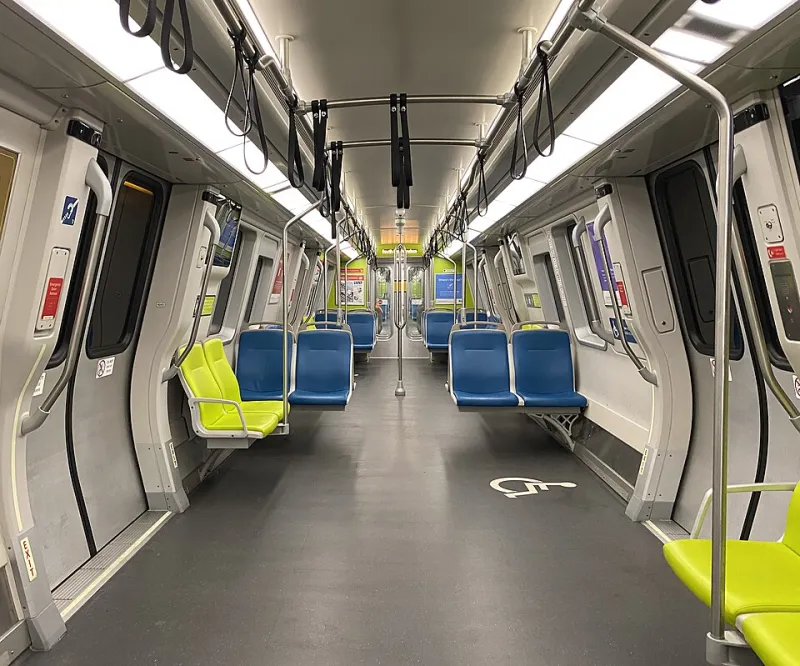
Photo: Sharon Hahn Darlin, CC BY 2.0, via Wikimedia Commons
Picture the scene. You've just boarded a train at Birmingham New Street. It's a busy service. The carriage is filling up. Your feet hurt. You spot a free seat — or what appears to be a free seat — only to discover that it is occupied not by a person, but by a North Face gilet, a tote bag from a bookshop that closed three years ago, and what might be a scarf or might be a very long sock. The actual human attached to these items is in the window seat beside them, staring at their phone with the focused intensity of someone who has absolutely heard you approach.
You stand there for four seconds. Then you shuffle to the other end of the carriage. You stand for the next forty minutes because the other available seats have their own coats, their own tote bags, their own invisible force fields radiating 'don't even think about it' energy.
This is British public seating in 2024, and it is quietly destroying us all.
The Physics of the Abandoned Coat
There is no rational explanation for why a coat on a seat commands more authority than a living human being's need to sit down, and yet here we are. The coat — or bag, or umbrella, or single glove — functions as a kind of social landmine. To defuse it, you must make eye contact, form words, potentially inconvenience a stranger, and then sit in immediate proximity to that stranger while both of you pretend the interaction never happened. For a British person, this is roughly equivalent to being asked to perform open-heart surgery on a moving bus.
The calculus involved is extraordinary. In the time it takes to decide whether to ask someone to move their jacket, a British person will have:
- Assessed the coat owner's approximate mood from their posture alone
- Considered whether they look like someone who would sigh audibly
- Wondered if they themselves look like the sort of person who asks people to move their things
- Decided they probably don't look like that person
- Concluded it is simply easier to stand
All of this happens in about two seconds. It is, in its own way, a remarkable feat of social processing.
The Hierarchy of Seat-Claiming Guilt
Not all coats are equal. There is an unspoken hierarchy of abandoned items and the varying degrees of guilt associated with asking for their removal.
At the least threatening end sits the lone carrier bag. This is clearly just a bag. It contains shopping. It does not have feelings. Most British people can, with sufficient preparation, ask for a carrier bag to be moved — though they will apologise twice before doing so and once immediately after.
Slightly more fraught is the handbag. A handbag suggests intention. Someone placed it there deliberately. It is a handbag, not a carrier bag — it has value, personality, possibly sentimental significance. Asking for a handbag to be moved feels vaguely like criticising someone's life choices.
Then there is the coat. The coat is the apex predator of the seat-blocking ecosystem. A coat means someone has actively removed a garment from their body and placed it somewhere. They made a decision. Overturning that decision requires you to become a part of their day in a way that neither of you will ever fully recover from.
At the absolute summit of untouchability is the coat-plus-bag combination. This is a person who has claimed the seat so thoroughly, so completely, that approaching them feels less like asking for a seat and more like challenging them to a duel.
What Happens in the Waiting Room
Trains are merely the most visible arena for this phenomenon. Waiting rooms — at GP surgeries, hospitals, and the sort of municipal offices that still have rows of plastic chairs bolted to the floor — present their own unique theatre.
Here, the abandoned item is often a coat draped over a chair beside someone who is either saving it for a companion or has simply decided they deserve two chairs today. The distinction matters enormously, because sitting in a saved seat carries a different social weight entirely. You might displace someone's spouse. You might sit on someone's lunch. There is no way to know, and British people, given the choice between asking and not knowing, will always choose not knowing.
GP surgery waiting rooms are particularly intense. Nobody wants to interact with a stranger in a GP waiting room. You are all there because something is wrong with you, and the social contract of the space demands total silence and deliberate non-acknowledgment of everyone else's presence. Asking someone to move their coat in this context is essentially announcing yourself. Nobody will do it. The coat wins. It always wins.
The Rare and Terrifying Act of Asking
Occasionally — rarely, like a solar eclipse or a functioning self-checkout machine — a British person will actually ask. 'Excuse me, is anyone sitting here?' The phrase is always a question, even when the answer is obviously no, because framing it as a question gives the coat owner an opportunity to say 'yes' and end the whole interaction, which everyone involved would secretly prefer.
When it goes smoothly, the coat is moved, thanks are exchanged, and both parties immediately establish a rigid wall of mutual non-acknowledgment for the remainder of the journey. When it goes badly — when the coat owner sighs, or takes a long time to move their things, or says 'I suppose' — the person who asked will spend the rest of the day quietly replaying it and wondering if they were rude.
They were not rude. They asked for a seat on public transport. But British guilt is not interested in proportionality.
Standing as a Lifestyle Choice
The end result of all this is that Britain is a nation of people who have quietly decided that standing is fine, actually. Standing is peaceful. Standing requires no negotiation, no eye contact, no apology. You can stand and look out of the window and pretend you chose this. You are not someone who couldn't get a seat. You are someone who prefers to stand.
The coat, meanwhile, rides in comfort all the way to Edinburgh.
And somewhere in a busy carriage, a British person shifts their weight from one foot to the other, glances at the empty seat, and decides — again — that it's probably fine.