Not a Biscuit in Sight: The Tin That Has Been Lying to Britain Since Before You Were Born
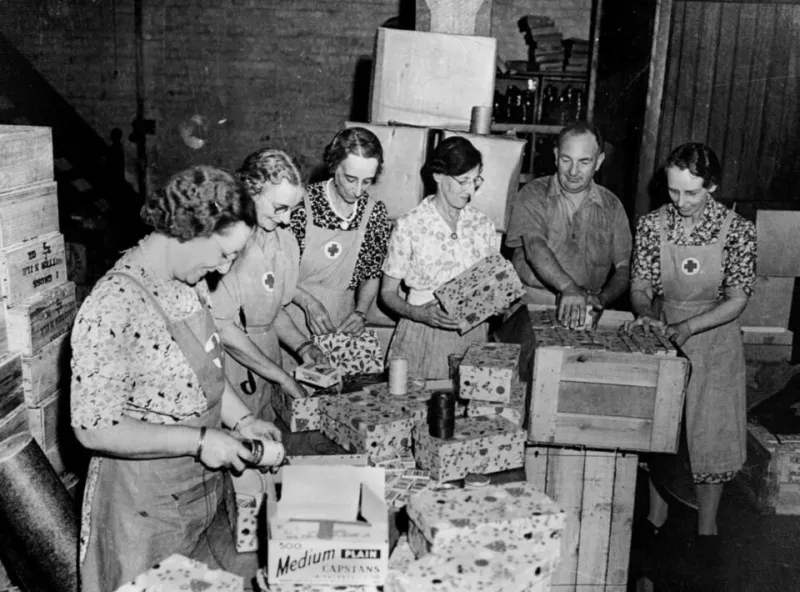
Photo: State Library of Queensland, Australia, No restrictions, via Wikimedia Commons
There is a particular kind of disappointment that is unique to Britain. Not the disappointment of a cancelled train, or a soggy bottom, or a bank holiday that delivers nothing but horizontal rain. This disappointment is older, more intimate, and frankly more devastating. It lives in the kitchen. Sometimes in the living room. Occasionally on a shelf in the spare bedroom that nobody goes into unless there's a guest and even then only briefly.
It is, of course, the biscuit tin that contains absolutely no biscuits whatsoever.
The Tin in Question
You know the one. It is usually round, occasionally rectangular, and always decorated with something aspirationally festive — a snow scene, a Victorian family gathered around a hearth, a selection of shortbread fingers arranged in a fan so elegant it borders on the offensive. The branding promises warmth. It promises comfort. It promises, above all else, biscuits.
What it delivers is a rattling collection of objects that have no business being stored together. Buttons in colours that correspond to no garment currently owned by anyone in the household. A thimble. Several metres of thread wound around a piece of card so old the card has begun to dissolve. Safety pins, some open, some closed, none of them the size you actually need. A mysterious metal hook. A needle already threaded with something beige. And, inevitably, at least one small screw whose origin is unknown and whose purpose has been forgotten, but which cannot be thrown away because what if it's important.
This is not a sewing box. It is a shortbread tin. It says so on the lid. And yet here we are.
The Archaeology of Hope
The cruelty of the biscuit tin betrayal lies in its architecture. The tin looks like a biscuit tin because it was a biscuit tin. Once, long ago — possibly before you were born, possibly before your mother was particularly old — someone in the family ate the biscuits that came inside it. They enjoyed them, presumably. And then, rather than recycling the tin or putting it in a cupboard to be forgotten in the conventional way, they made a fateful decision: they repurposed it.
From that moment forward, the tin ceased to be a vessel for confectionery and became instead a vessel for everything that doesn't belong anywhere else. The sewing bits. The spare batteries that might still have charge. The instruction manual for an appliance that was taken to the tip in 2003. A stamp. Half a birthday candle. A loyalty card for a coffee shop that closed during the pandemic.
And crucially — critically — nobody changed the lid.
The lid still shows the shortbread. The lid still makes the promise. Every single person who has visited that kitchen since the repurposing has, at some point, clocked the tin and felt a small, involuntary flicker of anticipation. And every single one of them has opened it and experienced the specific quiet grief of finding a thimble where a Viennese whirl should have been.
A Cross-Generational Agreement Nobody Signed
What makes the biscuit tin betrayal genuinely fascinating, from an anthropological standpoint, is that it persists entirely without enforcement. Nobody is making anyone keep sewing supplies in a shortbread tin. There are perfectly good sewing boxes available in every high street haberdashery and online retailer in the country. They have compartments. Proper ones. Some of them even have little trays that lift out.
And yet the tin endures.
This is because the biscuit tin sewing box is not really about storage. It is about inheritance. Your nan had one. Your mum has one. You will, if you are not extremely vigilant, end up with one. It passes between generations not through any formal process but through a kind of domestic osmosis — the tin simply appears in your kitchen at some point in your late twenties or early thirties, and you don't question it, because on some level you already know what it is and what it contains and you have made your peace with it.
The cultural agreement is this: we will all pretend, forever, that the tin might contain biscuits. We will all experience the hope. We will all experience the thimble. And we will none of us speak of it.
The Specific Horror of the Loose Screw
Of all the items found inside the British sewing tin that is not a sewing tin, the loose screw deserves its own moment of recognition. Unlike the buttons, which at least have an obvious category, or the thread, which has a clear function, the screw exists in a state of pure ontological uncertainty.
It is too small to be from anything structural. It is too specific to be a random spare. It has clearly come from something, at some point, and someone — your mother, your grandmother, a previous occupant of the house — decided that rather than throw it away, they would put it in the tin. For safekeeping. Just in case.
Just in case of what, precisely, is never specified. But the screw stays. It will be in that tin when the next generation opens it, rattling around among the buttons, catching on the thread, being briefly mistaken for something significant before being placed carefully back inside.
What This Says About Us
The biscuit tin betrayal is, when you think about it, a remarkably efficient summary of the British character. We are a nation that keeps things going long past their original purpose. We repurpose, we make do, we refuse to replace something that is technically still functioning even if it is functioning in an entirely different capacity to the one intended. We experience mild but genuine disappointment on a regular basis and we do not complain about it, we simply adjust our expectations and carry on.
Also, we are deeply, profoundly reluctant to throw away a screw.
The tin with the shortbread on the lid will outlast all of us. It will move house at least twice more, survive several kitchen refits, and be opened by people not yet born who will feel, just for a moment, the brief warm hope of biscuits — before finding the thimble, the buttons, and the screw, and quietly closing the lid again.
This is Britain. The tin is fine. Everything is fine.