Mugs: The Ceramic Chaos Quietly Destroying British Kitchen Sanity
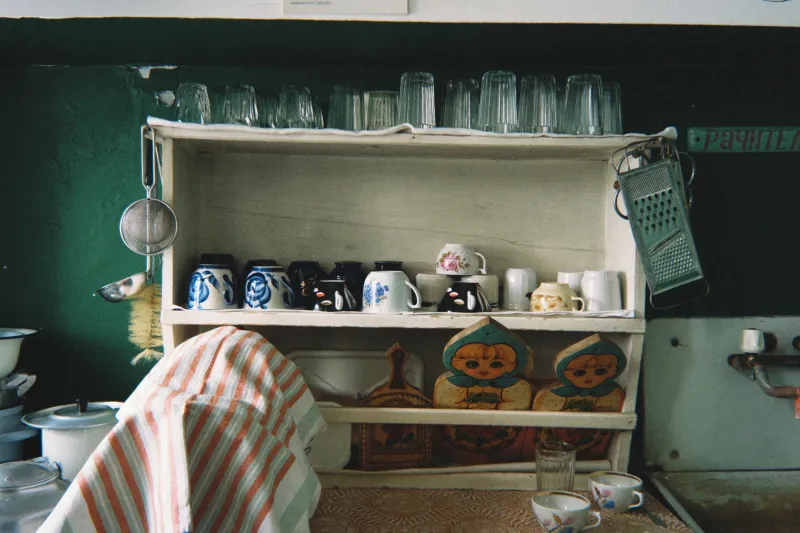
Open any British kitchen cupboard and you will be confronted with a ceramic avalanche. Mugs stacked three deep. Mugs wedged sideways. A mug from a National Trust gift shop in 2009 that nobody remembers purchasing but everyone is slightly afraid to throw away. By any reasonable accounting, the average British household possesses enough mugs to hydrate a small village. And yet — and this is the part that should concern us all — when you actually want a cup of tea, there is never a single clean one in sight.
This is not a coincidence. This is not bad luck. This is a uniquely British domestic catastrophe, and it deserves the serious investigative attention it has been so long denied.
The Great Accumulation: How Did We Get Here
Nobody in Britain deliberately sets out to collect seventeen mugs. It simply happens, gradually and without consent, the way moss grows on a garden wall or a drawer fills up with takeaway menus you'll never use.
There's the mug from that hen do in Benidorm. The one with a motivational quote that someone gifted you ironically but which has somehow outlasted three relationships. The commemorative Royal Wedding mug that you'd feel vaguely treasonous binning. The freebie from a conference in 2016 bearing the logo of a company that no longer exists. The one your nan gave you that's slightly too wide and always burns your fingers but feels spiritually important to keep.
And then there are the mystery mugs — the ones nobody can account for. They simply arrived. Perhaps they were left by a visiting friend. Perhaps they migrated from a previous house. Perhaps they manifested through some low-level ceramic sorcery that British homes are particularly susceptible to. Whatever their origin, they are here now, and they are staying.
The result is a cupboard situation that defies all logic. You have the means to make tea for an entire book club, a football team, and two plumbers simultaneously. Yet the practical reality of your mug supply is, at any given moment, essentially zero.
The Disappearance Problem
Here is where it gets genuinely troubling. Those seventeen mugs do not simply sit in the cupboard waiting patiently for their turn. They migrate.
A significant proportion of Britain's missing mugs are, at this very moment, sitting on desks — at home, at work, and in some cases at the desks of people who left those jobs over a year ago and simply never brought them back. Office mug theft is so normalised in this country that most people don't even register it as theft. It's more of a slow, passive relocation. Your mug goes to work with you on Monday. By Wednesday it has been absorbed into the communal kitchen ecosystem. By Friday it has been used by someone called Dave from Accounts and placed in the drying rack with absolutely no intention of being returned to you.
Then there are the car mugs. The ones that live permanently in the cup holder, accruing a faint brown tide mark, technically always available but never quite the right option for a proper sit-down brew. The bedside mugs. The shed mugs. The mugs that made it as far as the garden and have since been adopted as plant pot drainage solutions.
At any given point, perhaps four of your seventeen mugs are genuinely in circulation. The rest are on a gap year.
The Territorial Situation
Among the mugs that do remain in the kitchen, an entirely separate conflict is quietly unfolding: ownership.
In every British household, certain mugs are claimed. Not officially. Not through any verbal agreement or written contract. But claimed nonetheless, through the ancient and unspoken law of preference. Someone has a mug they always use. It might be the large one. The one with the slightly better handle. The one that holds just the right volume of tea without being ostentatious about it. This mug is theirs, and using it without permission is a domestic transgression roughly equivalent to eating someone's clearly labelled yoghurt from the shared fridge.
The problem is that nobody ever explicitly says this. The rule exists entirely in the ether, enforced only through sighs, pointed silences, and the quiet act of washing your own mug immediately after use to signal that you know exactly what you're doing and you'd prefer if it didn't happen again.
Housemates who are otherwise perfectly functional adults have been known to maintain cold diplomatic relations for weeks over repeated mug boundary violations. Couples have had conversations about mug allocation that were nominally about mugs but were, in actual fact, about something else entirely.
The Ones We Cannot Let Go
Logic would suggest that the solution is simple: have a clear-out. Keep six mugs — a sensible, functional number — and donate or discard the rest. This is, on paper, a completely reasonable proposal.
And yet.
There is always a reason to keep the weird ones. The chipped one that's been repaired with superglue and technically still works. The one you got free with a magazine subscription in 2003. The one that says something mildly offensive that you'd never actually use but feels like it might be worth something someday. Mugs accumulate emotional weight in a way that is entirely disproportionate to their status as functional objects. They are witnesses to countless cups of tea, early mornings, bad news, good news, and biscuits dunked in contemplative silence. You can't just bin that.
So you don't. And the cupboard remains full. And tomorrow morning, when you desperately need a brew and every single mug is sitting unwashed in various corners of the house, you will stand in the kitchen staring at an empty draining rack and feel, briefly, like the whole thing is a metaphor for something.
It probably is. But first, you'll need to find a clean mug.
Which, as ever, is going to take a minute.