Rip, Fold, or Finesse: The Crisp Packet Technique That Says Everything About You
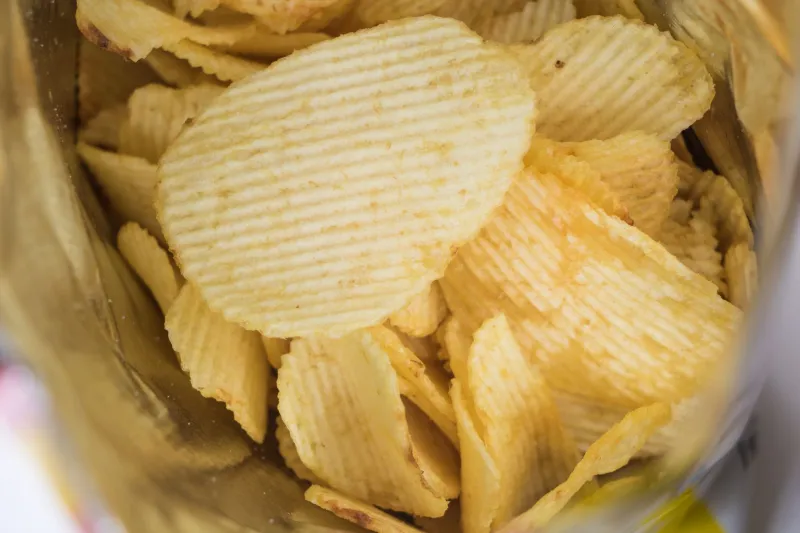
Somewhere in Britain right now, someone is ruining a perfectly good bag of Ready Salted. Not by eating them — that part's fine — but by the way they're going about getting into the packet. A savage tear from the side. A frantic squeeze-and-pop that sends three crisps skidding across the kitchen floor. Or, perhaps worst of all, the slow, deliberate, almost ceremonial unsealing along the top seam that takes so long the moment has entirely passed.
Crisps are supposed to be a simple pleasure. A snack. A thing you eat while watching the football or hovering near the buffet table at a christening. And yet, the humble crisp packet has quietly become one of Britain's most contentious domestic battlegrounds — right up there with the thermostat and who left the empty milk carton in the fridge.
The Techniques, Ranked by Social Acceptability
Let's be honest about what's actually happening out there.
The Top-Seam Methodist opens the bag by carefully pulling apart the heat-sealed top edge, thumb and forefinger working in slow, measured tandem. This person believes they are being civilised. Everyone else in the room believes they are being insufferable. The upside is a neat, wide opening that allows for dignified access. The downside is that by the time they've finished, the moment has passed and the crisps are somehow less exciting.
The Side-Ripper has no patience for ceremony. They grab the packet somewhere around the middle and tear laterally, creating an opening that is technically functional but aesthetically catastrophic. Crumbs immediately escape. The structural integrity of the bag is compromised. This person will tell you they're being efficient. They are not. They are being chaotic, and deep down they know it.
The Bottom-Up Rebel — and yes, these people exist — opens the bag from the bottom on the grounds that the best crisps, weighted by seasoning, have sunk to the lower half. This is the crisp packet equivalent of a conspiracy theory. It has internal logic. It is also completely unhinged.
The Sharer opens the bag fully down one side, flattens it out into a makeshift communal bowl, and announces "there you go" with the energy of someone who has just solved a problem nobody asked them to solve. This person is either at a picnic or has watched too many lifestyle videos. Either way, they mean well.
The Squeezer bypasses the seams entirely, grips the bag around the middle, and pops it open with a sharp clap of air pressure. This technique is loud, startling, and deeply satisfying to perform. It is less satisfying to witness at 7am in an office kitchen.
Why This Actually Matters (Sort Of)
You might be thinking: does it really matter how someone opens a crisp packet? And the answer, rationally, is no. Of course not. It's a foil bag containing fried potato slices. There is no objectively correct method. And yet.
Ask anyone in Britain how they open their crisps and you will get an answer delivered with the quiet conviction of someone sharing a deeply held moral position. There will be justifications. There will be mild disdain for alternative methods. There will, in some households, be an actual discussion about it — usually starting with "I just think it's easier to..." and ending with someone saying "well, I've always done it this way" as if tradition were sufficient grounds for anything.
This is, in microcosm, extremely British. We will find the point of contention in the most frictionless possible activity and we will hold the line on it.
The Office Crisp Problem
Few environments amplify crisp packet opinions quite like the open-plan office. The acoustics alone are enough to make any packet-opening technique feel like a personal attack. The Squeezer is universally despised between the hours of 2 and 3pm, which is, of course, prime crisp o'clock. The Top-Seam Methodist creates a peculiar tension — everyone is watching, nobody says anything, and the silence stretches on in a way that feels vaguely judgmental.
And then there's the crinkle. All crisp packets crinkle. It is the nature of the material. But somehow, in an office, the crinkle of a Tyrrell's at 11am feels like a statement. Not a hostile one, necessarily. Just... a statement.
The only universally accepted office crisp behaviour is to offer one to the person nearest you, which they will decline, and you will both pretend the interaction never happened.
The Folded-Bottom Contingent
A word must be said about the people who, upon finishing their crisps, fold the empty packet into a neat little triangle. This is not an opening technique, strictly speaking, but it is adjacent to the crisp packet discourse and it deserves acknowledgement.
These individuals — orderly, perhaps slightly too pleased with themselves — will fold the empty foil into a compact geometric shape before disposing of it. They will do this without comment, as though it's simply what one does. It is not what most people do. Most people scrunch the bag into a ball and lob it in the vague direction of the bin.
The folded-triangle people are not better than us. They just want us to think they are.
A Nation United by the Crinkle
For all its apparent divisions, the crisp packet debate is, at its heart, a deeply communal thing. We are all, regardless of technique, trying to get to the same destination: a handful of salty, crunchy bliss. The journey might look different — methodical versus chaotic, shared versus solitary, top-seam versus structural obliteration — but the destination is identical.
Britain consumes around six billion bags of crisps per year. That's six billion small, individual moments of decision: how do I do this? And six billion quietly different answers.
So the next time someone tears into a Prawn Cocktail from the side while you're sitting there carefully working the top seam, take a breath. They're not wrong, exactly. They're just wrong in their own particular way.
Which is, honestly, the most British sentence ever written.