Nobody Told You the Rules Because Nobody Was Going to Tell You the Rules: Surviving the British Pub
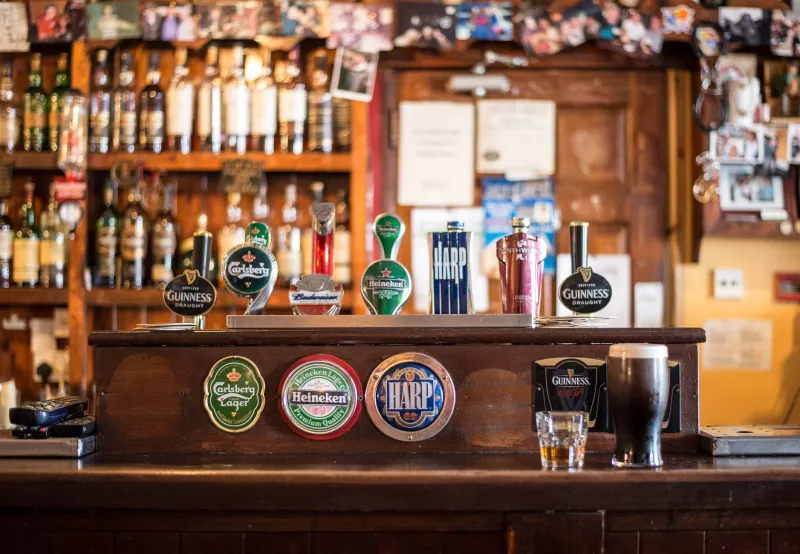
Walk into any British pub and the atmosphere will hit you like a warm, slightly beery hug. Chatter, laughter, the faint smell of something fried, and a general sense that everyone is having a lovely time. Lovely, that is, until you make a mistake. You won't know you've made it. Nobody will tell you. But somewhere across the room, a man in his sixties nursing a bitter will have clocked it, and he will carry that judgement silently to his grave.
Welcome to the pub. There are rules. There have always been rules. And the first rule is that no one explains the rules.
The Queue That Isn't a Queue (But Absolutely Is)
Let's start at the bar, which is where most disasters begin. In virtually every other context in British life, the queue is sacred — a physical monument to fairness and restraint. At the bar, however, there is no visible queue. There are no rope barriers, no ticket system, no polite signs. There is only a loosely organised crowd of people who all know, with absolute certainty, exactly whose turn it is.
This system operates on a kind of collective telepathy that takes years to develop. Regulars track it instinctively. Newcomers blunder in, wave a tenner, and accidentally jump three people they couldn't even see. The barmaid knows. The regulars know. The culprit has no idea and is already cheerfully asking for a Guinness.
The correct technique is to find your position, face the bar, and wait. Do not shout. Do not wave aggressively. Do not snap your fingers — honestly, if you snap your fingers at bar staff in a British pub, you may as well pack your bags. A subtle lean forward, perhaps a slight raise of the chin, a readied card hovering at the edge of the contactless reader. That's it. That's the whole move. Patience, presence, and the quiet confidence of someone who has absolutely been waiting longer than you.
Where You Stand Is Who You Are
Having successfully ordered without causing a diplomatic incident, you now face the spatial challenge of the pub itself. Where do you go? This seems simple. It is not.
Every pub has its geography, and it is understood by everyone who drinks there regularly. The stool at the end of the bar near the taps? That's Terry's stool. Has been for eleven years. Terry isn't here yet, but he will be, and you sitting on it is — well, it's not not fine, but it's noted. The table by the window? That's where the Thursday quiz team debrief. The high table near the door is for people who are only staying for one, and everyone can tell if you're lying about that.
As a newcomer, your safest bet is to head for the middle of the room. Not too close to the bar (you'll look like you're hovering), not too near the back (that's practically a private dining room), and absolutely not at the bar itself unless you're prepared to make sustained, occasionally unwanted conversation with strangers. The middle is neutral territory. The Switzerland of pub geography.
The Pint Nursing Olympics
British pub culture has a complicated relationship with pace. Drink too fast and you're showing off, or worse, you're getting a round in before anyone else is ready. Drink too slowly and you're holding up the rotation, which is its own kind of social crime.
The round system, for the uninitiated, is a finely tuned piece of social engineering. One person buys drinks for the group, then another, then another, cycling through until everyone has bought a round or the evening ends. The system depends entirely on everyone drinking at roughly the same speed. If you're lagging behind, you'll feel the gentle social pressure of four people staring into their nearly empty glasses while you're still halfway through yours. If you're racing ahead, you'll find yourself buying a round for people who didn't really need another one yet.
There is no official guidance on how to navigate this. You simply feel it. Like barometric pressure, but for beer.
Talking to Strangers (Up to a Point)
The pub is one of the few places in Britain where talking to a complete stranger is not only acceptable but occasionally encouraged. A comment about the football, a shared grimace at the telly, a brief acknowledgement of someone's dog — these are all legitimate entry points into conversation. The British pub, at its best, is a rare social leveller.
However. There are limits, and they are enforced entirely through body language. If someone is reading, they are not available. If someone is facing away from you, they are not available. If someone gives you a response of fewer than five words, they are wrapping up the interaction. The correct move is to accept this gracefully and return to your pint. Do not push. Do not try to reignite things with a follow-up anecdote. The window has closed.
Tourists, bless them, often miss this entirely. They interpret a polite one-liner as the beginning of a friendship and are baffled when the conversation fails to develop. It's not personal. It's just pub.
Last Orders and the Art of Not Being That Person
When the bell goes — or the lights flash, or the barmaid announces last orders in a tone that suggests she's been waiting to say it for an hour — there is a correct response and an incorrect one. The correct response is to decide whether you want another drink, go and get it promptly, and begin the gentle process of winding down. The incorrect response is to suddenly decide now is the moment for a large round, a complicated order involving mixers, or a request to see the cocktail menu.
There is no cocktail menu. There is a bell, and it has rung, and the barmaid has plans.
The Unspoken Masterpiece
What makes the British pub genuinely extraordinary is that none of this is written down anywhere. No laminated sheet behind the bar, no orientation video, no welcome leaflet. The rules exist in the collective consciousness of a nation that learned them the same way it learns most things — by watching, absorbing, and quietly judging those who haven't caught on yet.
Get it right, and you'll feel it. You'll fit into the rhythm of the place like you've been coming for years. Get it wrong, and you'll never quite know why the evening felt slightly off, why the bloke at the bar didn't quite warm to you, or why your pint seemed to take just a touch longer than everyone else's.
That's the pub. Chaotic, charming, and governed by an ancient code that nobody wrote and everyone knows. Cheers.