Suffering in Silence: The Unspoken Thermostat Diplomacy Holding British Homes Together
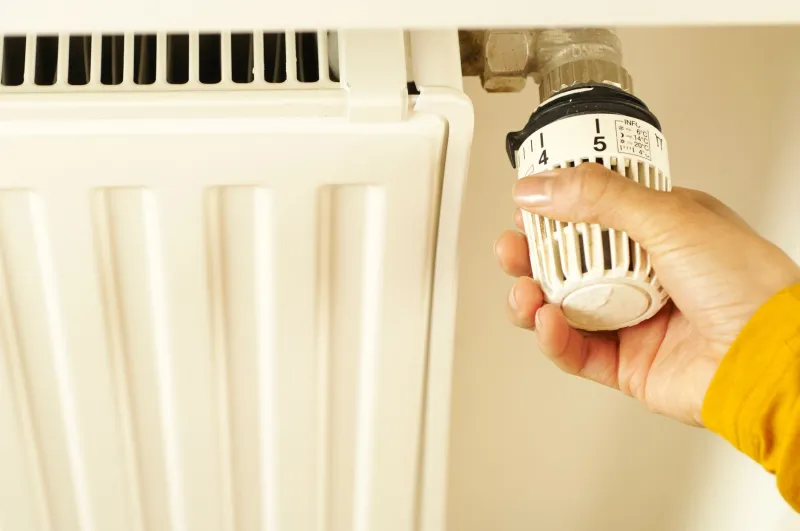
There is a thermostat on a wall somewhere in Britain right now. It has not been touched by human hands in eleven days. Around it, a family of four is conducting an elaborate, unspoken negotiation involving two extra jumpers, one aggressively opened window, a pointed comment about how the dog 'seems a bit warm,' and a mug of tea that was made not out of thirst but out of desperation for something — anything — that produces heat.
Nobody has said a word about the temperature. Nobody will. That would be rude.
Welcome to British domestic life, where the thermostat sits like a nuclear launch button — technically accessible to everyone, touched by absolutely no one, and capable of causing catastrophic social fallout if operated without unanimous unspoken consent.
The Shiver That Dare Not Speak Its Name
Let's establish the ground rules, because there are ground rules, even if they've never been written down or discussed. Actually, especially because they've never been written down or discussed.
Rule one: you do not simply turn up the heating. You suggest you might be a little chilly, ideally while rubbing your hands together in a theatrical fashion and gazing at nothing in particular. Rule two: the other party must not respond directly to this. They must instead either fetch you a blanket — silently, as an offering — or make a comment about how 'it's actually quite mild out,' which translates loosely to 'I am warm and I refuse to acknowledge your suffering.'
Rule three, and this is crucial: the person who eventually touches the thermostat loses. Not officially. Not out loud. But they lose.
This is Britain. We don't do confrontation. We do implication.
The Cardigan as Weapon
The British household's first line of passive-aggressive defence is, of course, knitwear. The donning of a particularly thick cardigan is not merely a practical response to cold — it is a statement. It says: I am cold. I am visibly, demonstrably cold. I have gone to the effort of fetching wool from upstairs. And still, I have not said a word, because I am a reasonable person.
The scarf worn indoors is an escalation. The fingerless gloves are practically a declaration of war.
On the other side of the conflict, you'll find the person who is too warm — typically stationed near a radiator with the expression of someone slowly being braised. Their weapon of choice is the Casually Opened Window. Not thrown open dramatically. Just... eased apart. A centimetre. Maybe two. Enough to let in a ribbon of February air while maintaining total deniability. "I just thought it smelled a bit stuffy," they'll say, if pressed. They will not be pressed.
The Vocabulary of Thermal Complaint
British people have developed an extraordinarily rich dialect for discussing temperature without ever actually discussing temperature. Linguists would have a field day. Here, for the uninitiated, is a brief translation guide:
"It's quite cosy in here, isn't it" — It is unbearably hot and I am considering removing a layer but feel I cannot do so without implied permission.
"I might just crack a window" — I am staging a unilateral cooling intervention and I'd like you to know about it but not comment on it.
"Are you not cold?" — I am absolutely freezing and I resent you enormously.
"I'm fine, I run warm" — I refuse to turn the heating up on principle and I'd like you to respect that about me.
"The dog seems restless" — I am using the dog as a proxy for my own discomfort and I hope you understand that.
"Cup of tea?" — I have no other tools available to me.
Why We Can't Just... Talk About It
Here's the thing: we know. We all know. Every British person reading this is nodding along with the weary recognition of someone who has spent forty-five minutes being cold in their own living room rather than ask their partner to nudge the dial up two degrees.
But why? What is it about the thermostat that triggers such spectacular emotional avoidance in an otherwise functional adult population?
Part of it is the deep-seated British conviction that physical comfort is, on some level, a moral failing. Complaining that you're cold implies weakness. Turning up the heating implies extravagance. Both are slightly embarrassing. Better to simply endure, quietly and with dignity, like your nan did during the winter of '63 and never let you forget.
Part of it is also the genuine fear of being the one who costs money. Energy bills being what they are, nobody wants to be the person who bumped the heating up and caused the quarterly statement to arrive looking like a ransom note. So instead, everyone suffers silently and heroically, and the bill stays the same because the thermostat hasn't moved since October.
And part of it — the most British part — is that asking someone to change the temperature feels alarmingly close to telling them what to do. In a shared space. Where they also live. Which is, apparently, the height of domestic presumption.
The Boiler as Relationship Barometer
Marriage guidance counsellors — if they were paying attention — would find the thermostat a remarkably useful diagnostic tool. Couples who can openly discuss heating preferences without either party performing elaborate suffering tend, anecdotally, to be doing rather well. Couples who have developed separate and competing microclimates within the same house, achieved through a combination of electric blankets, desk fans, and pointed silences, may wish to book a session.
It is not really about the temperature, of course. It never is. It's about whose comfort gets prioritised, who makes decisions, who feels heard, and who has spent three winters pretending they enjoy being slightly cold because they didn't want to seem demanding.
Deep stuff, for a small white box on the wall.
A Modest Proposal
Perhaps — and this is admittedly radical — we could simply say the words. "I'm a bit cold, could we turn it up?" Seven words. Perfectly reasonable. Entirely solvable. No cardigan required.
But then again, where's the fun in that? The silent negotiation, the knitwear diplomacy, the dog-as-proxy — this is the texture of British domestic life. It's maddening, it's absurd, and it is, in its own quietly unhinged way, completely wonderful.
Now if you'll excuse me, I'm going to put the kettle on.
I'm not cold. I'm absolutely fine. The scarf is just decorative.